

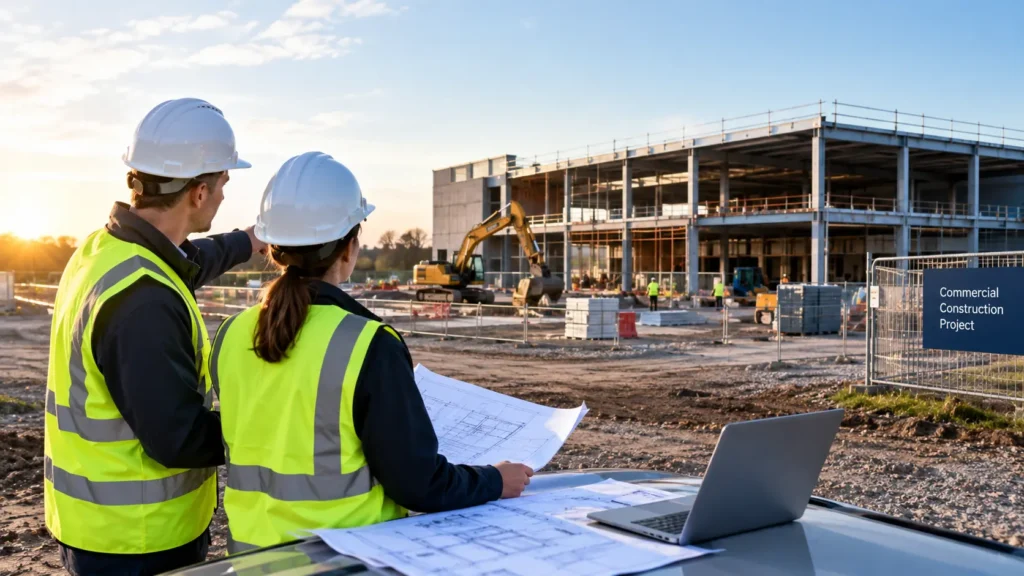
Choosing a commercial construction site UK businesses can develop successfully requires much more than finding affordable land in a convenient location. Planning potential, access, ground conditions, flood risk, utilities, environmental constraints and the total cost of development can all determine whether a site is genuinely suitable.
A site may look ideal during a viewing but become significantly more expensive once surveys reveal contaminated ground, inadequate drainage, restricted access or insufficient utility capacity.
In simple terms, the best commercial construction site is one that is suitable for its intended use, has realistic planning potential, workable access and infrastructure, manageable site risks, and a development cost that makes commercial sense.
The following checks can help businesses, developers and property investors assess a potential site before committing to the purchase or construction process.
1. Start With the Intended Commercial Use
The right site depends heavily on what you intend to build.
An office development does not have the same requirements as a warehouse, industrial unit, retail premises or mixed-use development. Before comparing sites, write down the practical requirements of the proposed project.
Consider:
- Required building size and floor area
- Vehicle and delivery access
- Loading and unloading requirements
- Parking
- Customer and employee access
- Storage
- Utility demand
- Operating hours
- Landscaping
- Security
- Future expansion
This sounds straightforward, but it can prevent an expensive mistake: buying land first and discovering later that it cannot comfortably accommodate the building and operational requirements.
2. Investigate Planning Potential Before You Buy
Planning should be one of the first checks when choosing commercial development land.
In England and Wales, you will generally need planning permission to build something new, make a major change to a building or change its use. The relevant local planning authority (LPA) handles planning applications. (GOV.UK planning permission guidance)
GOV.UK: Planning permission — when you need it
Before committing to a site, investigate:
- Existing planning designation
- Permitted uses
- Local planning policies
- Previous planning applications
- Building height restrictions
- Site coverage
- Parking requirements
- Access arrangements
- Heritage considerations
- Conservation-area restrictions
- Potential impact on neighbouring properties
The UK government also published How to assess and allocate sites for development on 31 March 2026, setting out principles and methods for assessing whether sites are appropriate for development.
Planning is therefore not something to leave until the building design is finished. The site’s planning potential should influence whether you buy the land in the first place.
3. Look Beyond the Address: Assess Access and Traffic
A commercially attractive location is not automatically a practical construction site.
Imagine a warehouse with excellent road visibility but a narrow approach road that makes HGV movements difficult. Or an office development in a convenient area where parking and public transport capacity are already under pressure.
These details can affect both planning and long-term business operations.
Assess:
- Connection to major roads
- HGV access where required
- Delivery routes
- Junction arrangements
- Parking
- Public transport
- Pedestrian access
- Emergency access
- Expected traffic generated by the completed development
Planning authorities can consider available infrastructure, roads, water supply and the traffic impact of a proposed development when assessing an application.
For logistics, industrial and trade-related projects, access should be tested against the actual vehicles that will use the completed building—not simply against the dimensions shown on a site plan.
4. Investigate Ground Conditions Before They Become a Cost Problem
Ground conditions are easy to overlook when you’re focused on location and purchase price.
They can also become one of the most expensive surprises in a construction project.
A proper assessment may need to investigate:
- Soil conditions
- Made ground
- Groundwater
- Ground stability
- Previous land uses
- Contamination
- Ground gases
- Foundation requirements
GOV.UK guidance notes that contamination can affect human health, property and the wider environment and can restrict or complicate development. It also recommends appropriate investigation where contamination may be a concern.
This is particularly important for previously developed or industrial land. Historical uses can provide useful clues, but a desktop search alone cannot establish the actual condition of the ground.
Where contamination is suspected, competent professional investigation may be required before the development can proceed confidently.
5. Check Flood Risk and Drainage Early
Flood risk is another factor that should be investigated before land is purchased.
The Environment Agency’s planning guidance covers when a Flood Risk Assessment may be required and what information should be considered. The guidance was last updated on 28 May 2026.
Check:
- Flood Zone classification
- Surface-water flood risk
- Groundwater risk
- Existing drainage
- Nearby rivers and watercourses
- Sustainable drainage requirements
- Potential climate-change considerations
- Site access during severe weather
For sites in England, the government provides a Flood Map for Planning that can be used to investigate flood-risk information.
Flood Map for Planning — official government service
Don’t treat flood risk as simply a yes-or-no question. A site may be developable but require additional assessment, mitigation or drainage measures that affect the design and budget.
6. Confirm Utilities and Infrastructure Capacity
A nearby electricity pole, water main or existing commercial building does not necessarily mean your proposed development will have sufficient utility capacity.
Check the availability and capacity of:
- Electricity
- Water
- Foul drainage
- Surface-water drainage
- Gas, where required
- Telecommunications
- Broadband infrastructure
For energy-intensive commercial uses, electricity capacity deserves particular attention. A site that cannot obtain the required connection within the project’s commercial timeframe may be less attractive than an alternative site with better infrastructure.
Obtain information about connection availability and potential upgrade costs early enough for them to influence your site-selection decision.
7. Identify Environmental and Heritage Constraints
Environmental issues can influence planning, design and construction.
Investigate whether the site or surrounding area contains:
- Protected habitats
- Protected species
- Mature or protected trees
- Watercourses
- Ecologically sensitive areas
- Contaminated land
- Listed buildings
- Conservation-area constraints
- Other heritage assets
The important point is timing.
Finding an environmental constraint before purchasing land gives you an opportunity to reconsider the site or adapt the proposed development. Finding it after substantial design and professional costs have already been incurred gives you far fewer options.
For potentially contaminated sites, government guidance also recommends proportionate investigation and early consideration of the risks within the planning process.
8. Compare the Total Development Cost
Land price is not the same thing as site cost.
This distinction is particularly important when comparing several commercial sites.
A cheaper plot may require:
- Demolition
- Extensive clearance
- Ground remediation
- Piling or specialist foundations
- Major earthworks
- Drainage infrastructure
- New access arrangements
- Utility upgrades
- Flood mitigation
- Additional professional investigations
Meanwhile, a more expensive site may already have good access, established utilities and relatively straightforward ground conditions.
So instead of asking only:
“Which site has the lowest purchase price?”
ask:
“Which site gives us the most predictable route from land purchase to completed commercial building?”
That is a much more useful commercial comparison.
9. Think About the Construction Process, Not Just the Finished Building
A site needs to work during construction as well as after completion.
This is where early construction input can make a significant difference.
Consider where cranes, plant, delivery vehicles, skips, welfare facilities and temporary materials will go. Think about neighbouring properties, working-space restrictions, road access and whether construction traffic can safely reach the site.
A constrained site may still be viable, but the construction methodology and logistics need to reflect those constraints.
For this reason, bringing a commercial construction contractor into the discussion before final site selection can help identify practical problems that are easy to miss during a property search.
10. Consider Future Expansion and Commercial Viability
Don’t assess the site only against today’s requirements.
Ask what the business may need in five or ten years.
Could the site accommodate:
- A building extension?
- Additional parking?
- More storage?
- Larger loading areas?
- Additional plant?
- Another building?
- Additional floors?
You should also investigate planned development around the site. New roads, housing, commercial schemes and infrastructure can change traffic patterns, accessibility and the long-term attractiveness of an area.
The government’s current site-assessment framework also emphasises assessing factors such as suitability, availability and achievability when considering development potential.
A Practical Commercial Site-Selection Test
If you’re comparing several potential sites, don’t rely on instinct alone.
Create a simple assessment table and score each site against:
| Factor | Key question |
|---|---|
| Planning | Is the intended use realistically achievable? |
| Access | Can employees, customers and delivery vehicles reach it? |
| Ground | Are soil, stability and contamination risks understood? |
| Flood risk | Could flooding or drainage affect the project? |
| Utilities | Is sufficient capacity available? |
| Environment | Are ecological or heritage constraints manageable? |
| Construction | Can the site be built on efficiently and safely? |
| Cost | What is the likely total development cost? |
| Expansion | Can the property support future growth? |
| Location | Does the site make commercial sense for the business? |
This gives you a more objective basis for comparing land than purchase price alone.
Why Early Professional Advice Matters
The earlier site problems are identified, the more options you have.
A planning consultant may identify a policy issue. A surveyor may identify a boundary or access concern. A geotechnical specialist may identify difficult ground. An environmental consultant may identify contamination or ecological constraints. A commercial construction contractor can then help translate those findings into practical construction implications.
At Ultimate Build Teams, our commercial construction work is focused on coordinating the practical requirements of commercial building projects from planning through construction.
Explore Ultimate Build Teams’ commercial construction services
Getting the construction perspective involved early can help ensure that the site you select is not merely capable of receiving planning permission, but is also practical to build on.
Commercial Construction Site Selection Checklist
Before committing to a site, confirm that you have investigated:
- Intended commercial use
- Planning policies and permission requirements
- Road and vehicle access
- Parking and transport
- Ground conditions
- Contamination risk
- Flood and drainage risk
- Utility availability and capacity
- Environmental and heritage constraints
- Construction logistics
- Total development cost
- Future expansion potential
If several of these questions remain unanswered, further due diligence is advisable before committing to the purchase.
Frequently Asked Questions
What is the most important factor when choosing a commercial construction site in the UK?
There is no single factor that applies to every project. Planning suitability, access, ground conditions, infrastructure, environmental constraints and total development cost should be assessed together against the proposed commercial use.
Should I check planning permission before buying commercial land?
Yes. You should investigate the site’s planning position, relevant local policies and whether the proposed commercial use is realistically achievable before committing to purchase. GOV.UK confirms that new construction and major changes to buildings or their use will generally require planning permission unless an applicable exemption or permitted development right applies.
What is a Flood Risk Assessment?
A Flood Risk Assessment examines how flooding could affect a proposed development and how the development could affect flood risk. Depending on the site’s location and the proposed development, an FRA may be required as part of the planning application.
Why should commercial land be investigated for contamination?
Previous industrial or commercial uses can leave contamination in soil or groundwater. Identifying potential contamination early allows the risks, investigation requirements and possible remediation costs to be considered before major investment is committed.
Is the cheapest commercial construction site always the best?
No. A lower purchase price can be offset by expensive foundations, remediation, drainage, utility upgrades, difficult access or planning constraints. The better comparison is the likely total cost and risk of developing each site.
Final Thoughts
Choosing a commercial construction site UK businesses can develop successfully is ultimately a due-diligence exercise.
The right site should fit the intended commercial use, have realistic planning potential, provide workable access and utilities, and present ground, flood and environmental risks that can be managed within the project’s budget.
The cheapest plot is not automatically the best investment. In many cases, paying more for a site with fewer constraints can produce a more predictable construction programme and a clearer route to completion.
Before purchasing commercial development land, consider obtaining appropriate planning, surveying, environmental, engineering and construction advice. A relatively small amount of investigation at the beginning can prevent much larger problems later.